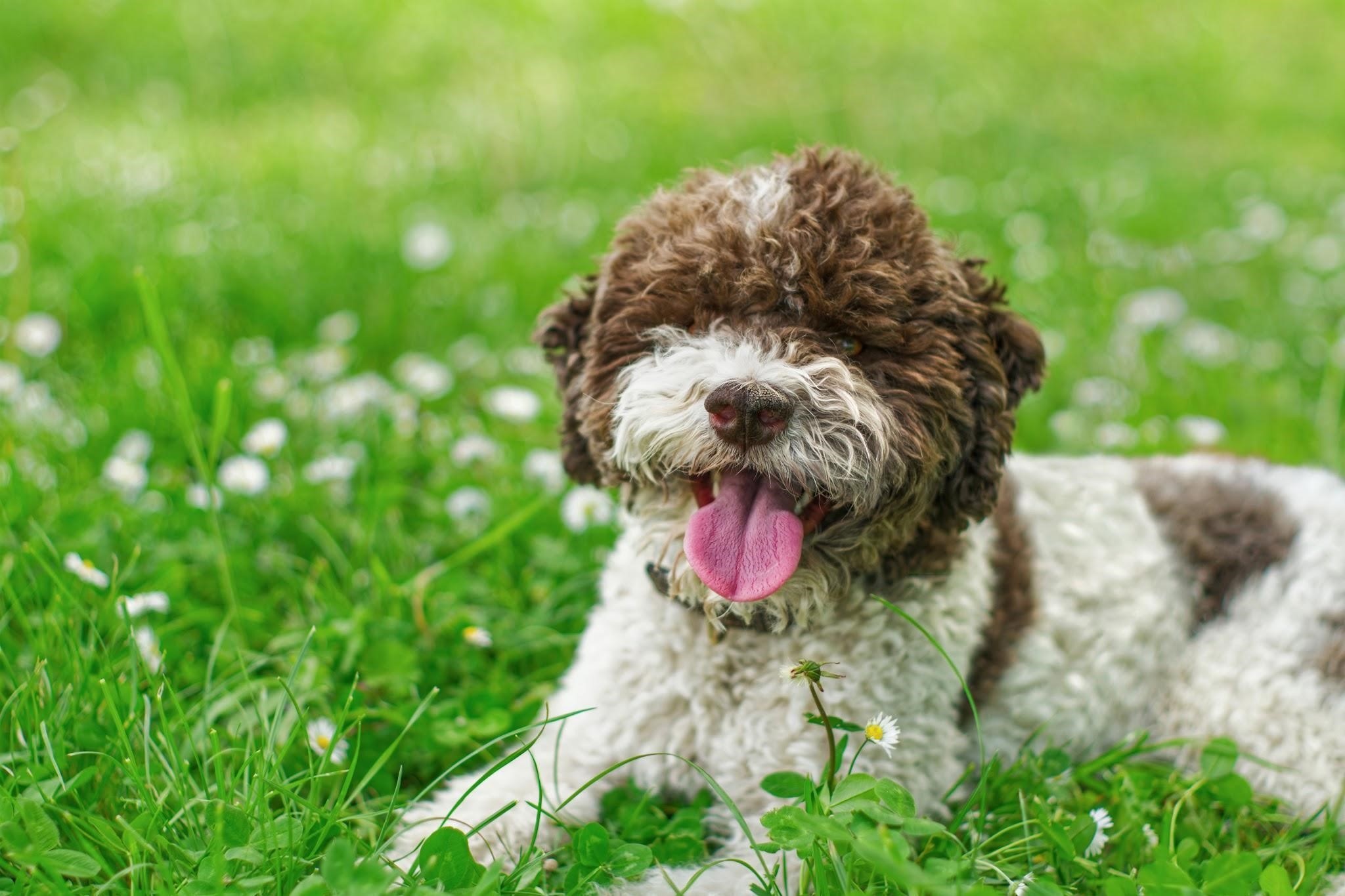
You have been wishing for a loving companion. You know this will brighten your days. You know this will give you more fun in your life and you will be healthier emotionally, and physically. Would you really go for a walk on your own without a motivating puppy to walk with? A beautiful cute small, soft, fluffy, wavy coated puppy, who looks at you with beautiful human colored eyes and loves you so much.
Within weeks, you realize this puppy is smart, confident, well socialized, and wants to please you.
BRIEF HISTORY OF THE BREED LAGOTTO ROMAGNOLO
The ancient 7th century BC Italian Lagotto Romagnolo breed known as the “original water retriever” worked for centuries with hunters to retrieve waterfowl with its adult wooly water resistant coat made of hair. They also retrieved fowl in the fields.
Similar appearing dogs to are featured as bird retrievers and companions in 7th century BC Frescoes in Italy. Ancestors were found during the medieval time period from 500-1500 AD. The lagotto ancestor was THE BIRD DOG that hunters used. These dogs were still found in Italy around the 8th century BC (Etruscan times).
There are many famous Renaissance paintings specifically in the !450s-1470s, Andrea Mantegna painted frescoes between 1465-1474 in the Bridal Chamber of the Ducal Palace at Mantua of a similar looking dog at the feet of the Marquis Ludovico Gonzaga.
For centuries there were many paintings of what appears to be lagotti romagnolo ancestors living and working with people.
Before guns the lagotti were trained to drive flocks of birds from the marshes into nets. They were structurally perfect for this job, as they have web feet, and are strong swimmers. They can swim for hours. Their curly hair prevented water from getting onto their skin which allowed them to work in icey waters, They could run on land with their sturdy balanced body. If birds got away into bushes, their medium size allowed them to get into thick bushes after them. Their ability to scent things out is one of their most amazing features. They very are eager to please their owner.
We have proved through our confirmation showings that we understand structure, temperament, and movement. We pass this on to others through our puppies. Our goal is for you get a healthy puppy so you will fall in to love with this breed. Others will learn through you how wonderful these dogs are, and you will then join us in helping to save this endangered breed. In 2015 the American Kennel Club (AKC) recognized this breed with about 500 dogs. In September of 2021, the Canadian Kennel Club ·CKC) recognized this breed. The number of lagotti has slowly grown to close to one thousand lagotto romagnolo puppies born in 2025 in all of North America.
If you’re evaluating your options, our guide on How to Choose a Responsible Lagotto Romagnolo Breeder? breaks down exactly what responsible breeding looks like; and if you want to know about the traits of this breed, this discussion covers its history, personality, appearance, health and care requirements, and more, helping readers make an informed choice before adopting one.
Where Does The Lagotto Romagnolo Come From?
The breed’s history goes back many centuries, when it was used as a water retriever for waterfowl hunters in the marshlands of Romagna, Italy. Italy used to be a part of the Roman Empire. The Latin word Romania means land inhabited by Romans. The territory was under Eastern Roman Byzantine rule during the middle agesand became separated from its neighboring territories centered around the Exarchate of Ravenna. Romagna is a sub-region in Northeastern Italy, encompassing , marshes, lowlands, and the lagoons of the Delta del Po. This pointing sporting breed brought back birds shot by hunters to boats or on land to their owners. Adults have a thick, curly coat made of hair that becomes wool like, Ideal for the cold, wet environment that doesn’t allow water to touch its skin. Therefore, they can be in very cold icy water. The lagotto romagnolo breed was easy to train because of its cooperative nature to be with people.
Why did this breed almost become extinct when it is such a fabulous dog?
This breed was extremely valuable as a bird water retriever in the marshes in of Italy. The original role of the dog was lost when the huge areas marshes were drained in the 19th century, turning marshland into farmlands. Then the industrial age came in the 1880-s to the 1914. The most rapid growth of people leaving the farms the to work in factories in the cities was after 1945. Dogs weren’t taken to the city to live in people’s small apartments. Hunters didn’t hunt their own food as they had in the past. Less dogs were bred because of lack of demand.
From Marsh Retriever to Truffle Hunter
Some hunters who stayed on the farms quickly realized the breed’s incredible scenting ability and used them to hunt underground truffles, which continues to this day, more effectively than any other breed. Since there weren’t very many lagotto romagnolo breeders many of these dogs some of these dogs were cross bred to other dogs.
A group of dedicated Lagotto Romagnolo breeders, vets, and dog enthusiasts worked for more than 20 years to save the breed from extinction. They had to classify the breed structure. They had to find the purest lagotti and build up a gene pool to breed to each other until once again there was a purebred breed again.
Through their efforts, they restored a consistent, pure breed according to the Lagotto Romagnolo Club of Great Britain, followed by official recognition.
For owners curious about developing this instinct at home, our guide How to Train a Dog to Find Truffles: The Complete Beginner’s Guide walks through the process step by step.
Understanding Lagotto Temperament and Personality
One of the most appealing aspects of Lagotto temperament is that they love people and are good living with one person or a family. They are usually easy to train as they are food motivated, affectionate, alert, and eager to please. They have attention that can be used to hunt waterfowl, or truffles. They are not high energy like unless they are working at a task.
A Lagotto’s personality is an affectionate and an attentive companion. They form deep bonds with their humans, love to settle down and cuddle, and like to be included in daily activities. They are intelligent and eager to please. They excel in agility, and obedience.
You can go walking, hiking, swimming, cross country skiing, running, as they are hearty but are not high energy unless they are in an activity that requires it. Hiking altitude does not bother them. They are a very versatile dog that molds to your lifestyle.
A closer look at common Lagotto traits shows what daily life with the breed really involves:
- Highly food-motivated, which makes reward-based training especially effective
- Strong nose-driven instincts, some have a tendency to dig but they can be trained not to dig
- Good with children and other pets when socialized early
- Breed does not require a lot of food
- When hiking will go ahead but comes back to you often
Families looking to know about Lagotto Romagnolo with kids usually find that the breed’s playful, gentle nature makes it an easy fit for children of all ages. Humans must make sure the puppy is trained not to jump up on people so they don’t knock over a small child.
Lagotto Size
The Lagotto Romagnolo is a medium “square” size dog. This means that the length of its body measured from its chest to the end of the buttock, is roughly equal to the dog’s height. The height is the distance from the ground to the top of its withers which is the top of the shoulder. This form presents a standing “four square” which means the body is balanced with all four legs placed directly and evenly under its shoulders and hips. The lagotto romagnolo presents with a steady solid posture, alert, and capable of smooth graceful movement.
How Big Does a Lagotto Romagnolo Get? The table below breaks down adult average height and weight by gender.
| Trait | Males | Females |
| Height | 17–19 in | 16–18 in |
| Weight | 28–35 lbs | 24–31 lbs |
| Lifespan | 15–17 years | 15–17 years |
| Coat | Dense, hair, no dander, firm, curly, water-resistant | Dense, hair, no dander, firm, curly, water-resistant |
therefore has almost no shedding like a human. Their hair doesn’t have a wet dog odor. The hair is wavy as a puppy and becomes water resistant tight wool-like curls. They don’t have dander that falls to the ground like fur dogs.
Lagotti don’t drool which reduces allergy triggers from saliva.
Is the Lagotto Romagnolo Hypoallergenic?
The Lagotto Romagnolo is a medium size dog that is classified as hypoallergenic for several reasons. They have hair like people and therefore has almost no shedding like a human. Their hair doesn’t have a wet dog odor. The hair is wavy as a puppy and as it gets older the hair becomes water resistant tight wool-like curls. They don’t have dander like fur dogs.
Lagotti don’t drool which reduces allergy triggers from saliva.
No breed is completely 100% allergy free to all people.
The Lagotto Romagnolo breed is a wise choice for allergy-prone families, though, as we cover in our blog Is the Lagotto Romagnolo Hypoallergenic?, no breed is completely 100% allergy-free to all people.
As far as Coat color is concerned, another common question new owners ask is:
What Colors Do Lagotto Romagnolo Puppies Come In?
For the full range of shades, Truffle Dog.COM lists the full variety that the American Kennel Club (AKC) recognizes.
Colors that is not allowed: AKC official club standardds do not allow a black or gray coat, this includes balck or gray patches, or black skin pigmentation. The nose of a logotto is not allowed to be black. The nose color can shade from a flesh like color to a light pinkish brown all of the way from a light brown to a dark brown color.
Coat Colors :
Base Coloring with a variety of Markings of the different colors below:
Brown: Light brown tones to a dark brown with or without white patches or with orange patches.
Orange: Color ranging from a solid orange, to a light apricot, with or without white patches.
Off-White: solid cream or off-white color shades base with brown or orange patches.
White: A white base with or without minor shading or patches.
Patterns of Colors:
Roan: Is an intermingling mixture of colored and white hairs. The color can be brown roan, or orange roan.
Brown masks: specific pattern of darker brown hairs around the eyes, face, and muzzle that appears as a mask. The mask shows because it is darker than the base color coat.
Tricolor with and without a distinct “Tan Point Pattern”
The rarest colorings of Lagotti is called a tri-color which usually presents as a brown or a brown roan coat (an even mix of brown and white hairs intermingled) with white or brown patches and tan markings. The base colors of a tricolored lagotto must be within the brown, orange roan, or white palette. The coat has a distinct three color distinction.
Any lagotto that has three colors is a tricolor even though the three colors might be in various areas of the body such as the ears.
Tan markings: can be honey, apricot, or fawn colored .
Tan Point Pattern: This genetic trait creates specific symmetrical tan markings above each eye, on the muzzle, chest, legs, and under the tail. They always appear in the exact same areas that would be seen on several breeds such as a Doberman, Rottweiler, Pinschers, Gordon Setter, Black and Tan Coonhound and a few other breeds.
Why are TRICOLOR lagotto so rare?
Because the specific “tan point gene” is a recessive trait. This means a puppy must inherit a copy of the tan point gene from both of its parents. The particular gene is one of the rarest color expressions in the entire breed. Because it is so difficult to obtain with two breeding pairs, it is highly prized among breed enthusiasts but incredibly difficult for breeders to produce consistently.
TO FIND OUT WHY The Lagotto Romagnolo is called to have a “Chameleon Coat”, so special, so unique? How does the Lagotto Romagnolo coat change from puppy to adult? READ THE TRUFFLEDOG BLOG
Size, Health
How Big Does a Lagotto Romagnolo Get? The table below breaks down average height and weight by gender.
| Trait | Males | Females |
| Height | 17–19 in | 16–18 in |
| Weight | 28–35 lbs | 24–31 lbs |
| Lifespan | 15–17 years | 15–17 years |
| Coat | Dense, curly, water-resistant | Same |
If you’re evaluating your options, our guide on How to Choose a Responsible Lagotto Romagnolo Breeder? breaks down exactly what responsible breeding looks like; and if you want to know about the traits of this breed, this discussion covers its history, personality, appearance, health and care requirements, and more, helping readers make an informed choice before adopting one.
DOES YOUR BREEDER TEST AND PUBLISH THEIR DOGS Canine Health Information Center (CHIC) TESTING?
AKC parent clubs work with OFA to determine what breed specific testing is required for every pure breed. OFA has a public site that lists breed-specific health testing that we publish under our Lagotti by name and AKC number. WHY?
IT is a reliable centralized database that is open public disclosure (if the owner allows) of the specific breed required CHIC testing. The dogs of that breed are tested for the specific problems of that breed. By knowing the health tests of specific issues that the breed is known to have a potential problem with helps owners, breeders, and buyers choose if they want a puppy from that specific dog. It tracks breed-specific health trends and identifies common genetic and other issues. It helps breeders to keep the small gene pool of the endangered lagotto healthy.
To earn a CHIC number, the specific health screenings recommended by the Lagotto Romagnolo Club of America are submitted to the Orthopedic Foundation For Animals database. The dog’s owner submits the required health information and sometimes additional tests that the owner deems pertinent. Owners do NOT have to make their dogs information known, but they are not eligible for a CHIC# unless the testing meets the requirements and the health information is able to be looked at by the public. The owner must make the tests public and the dog has to pass specific requirements to earn a CHIC# which is the highest health screen required for purebred breeds at this time. The transparency and integrity of looking up the lagotto’s health information buyers confidence that they are buying from a responsible breeder.
What is required CHIC health tests for the Lagotto Romagnolo?
Hip dysplasia: which measures the hip laxity/distratction and is useful for measuring hip dysplasia. This test is not a pass or fail. It gives information of the hip distractions.
Testing involves either a PennHip xray done at 16 weeks or older, or OFA final hip certification at 24 months or older.
Patellar (Kneecap) Luxation:
This test is a pass or fail. It is evaluated by a veterinarian and graded as to the degree the kneecap slips out of its anatomical groove during normal movement and manual manipulation by the veterinarian.
Eye Examination: Officially known as the Companion Animal Eye Registry/CAER exam)
This exam is not a pass or fail. It is performed by a board-certified veterinary ophthalmologist that evaluates to see if the eyes have any physical abnormalities, which could be an inherited eye issue. To get a CHIC number there has to be a certified passing eye test. There is no minimum age for this test. For breeding purposes, the Lagotto Health protocol calls for annual eye examinations.
Genetic Disease testing for the two as follows. This is a pass/fail test/ If the dog is clear/normal for no copies of the gene, that is a pass. If the dog is a carrier of the genetic disease and has one copy of the disease gene, that is a pass. If the dog has two copies of the disease gene, it means the dog is affected by the disease and fails.
The GENETIC Health Issues that Every Owner Should Be Aware of
It is imperative that your puppy’s parents have been tested for the two known genes
that the AKC parent club and Orthopedic Foundation for Animals (OFA) want breeders to conduct a one-time DNA swab or blood test on each breeding parent.
BENIGN FAMILIAL JUVENILE EPILEPSY (BFJE) is an inherited disorder when a puppy receives both the gene that causes this from both parents. It is an inherited neurological disorder that causes symptoms in the puppy usually between 5 and 9 weeks old. Affected puppies have body tremors, focal seizures, muscular stiffness, and an uncoordinated walk (ataxia). The symptoms almost always stop when the puppy is about 4 months old. Many lagotti carry one of the mutated gene which means they are a carrier but NOT affected.
A long-term follow-up study tracked Lagotto Romagnolo dogs with a documented history of benign familial juvenile epilepsy, monitoring their behavior and health well after the seizures had resolved, as published in the Journal of Veterinary Internal Medicine.
Lagotto Storage Disease (LSD) also called Lysosomal Storage Disease is another inherited disease that has no cure and is always fatal. Puppies do not outgrow this one. LSD is a fatal neurodegenerative disease that LSD which is unique to this breed only.
This inherited disorder that is checked by all reputable breeders can be checked so the breeding pair cannot pass on this FATAL disease to their puppies. LSD is a fatal neurogenerative disease which is unique to this breed.
The disease causes a deficiency where the enzyme responsible for recycling metabolic cellular waste. The waste then builds up inside the lysosomal cells. This build up is toxic and directly destroys neurons in the puppy’s brain cerebellum that controls balance, muscular movement, and coordination. The puppy will be clumsy in walking.
The onset of LSD symptoms of incoordination and balance with movement is usually between 4 months and 4 years. Other symptoms might include abnormal eye movement called nystagmus, and some have behavioral changes such as restlessness and aggression.
Once again, the puppy must inherit two LSD genes (one from each parent). The parent can be a carrier with only one gene and not affected.
This inherited disorder that is checked by all reputable breeders can be checked so the breeding pair cannot pass on this FATAL disease to their puppies. LSD is a fatal neurogenerative disease which is unique to this breed.
Reputable breeders now screen the potential parents with genetic DNA testing.
WHY DOES TRUFFLE DOG COMPARE ALL OF THE GENES EACH PARENT HAS TO EACH OTHER BEFORE BREEDING?
We compare all of the approximately 300 genetic diseases that we get on the DNA report, not just the two specific Lagotto Romagnolo diseases that are required for a CHIC #. We do this for the BEST HEALTH WE CAN GIVE TO YOUR PUPPY.
We personal know of of two breeders whose parent dogs were carriers of Progressive Retinal Atrophy (PRA). Both the male and the female lagotto romagnolo were carriers of PRA. This means they only had one of the two genes and therefore they were not affected by this disease.
Unfortunately, the PRA disease is not required by the joint program of AKC Lagotto breed club the OFA Canine Health Information Center testing requirement for Lagotti. They only recommend the testing of 2 genetic diseases for lagotti.
Both of the two breeders, while following AKC and OFA guidelines did not check for PRA. Both their Dam and the Sire were carriers and almost all of the puppies in their large litters had severe sight issues by 6 months and almost all went blind in a few years.
To explain the percentage if both parents are carriers of the same autosomal-recessive PRA mutation, the genetics are:
Puppy’s genetic result Chance
Clear-2 normal copies of genes 25%
Carrier-1 normal + 1 PRA gene 50%
Affected with 2 PRA genes 25%
That means statistically if there were 4 puppies in the litter, 25% which is the probability of each individual puppy getting PRA (both genes positive for PRA) . That would mean the puppy get one gene from both parents so both of the puppy’s two copies of genes were postitve for the disease meaning that puppy will have the disease.
BUT 50% of the puppies in this litter had PRA. The 25% is THE PROBILITY FOR EACH PUPPY. The reason that half and not one-fourth of these puppies had PRA is because each of these puppies got a PRA copy from both parents. They all could have gotten both copies or no copies but only half did.
DOES YOUR BREEDER TEST AND PUBLISH THEIR DOGS Canine Health Information Center (CHIC) TESTING?
AKC recommends two genetic DNA tests for Lagotti. OFA has a public site that lists our Lagotti by name and AKC number. OFA requires more testing for each lagotto. WHY?
IT is a reliable source that is open public disclosure (if the owner allows) of the specific required CHIC testing is so the dogs of that breed are tested for the specific problems of that breed. By knowing the health tests of specific items that the breed is known to have a potential problem with helps owners, breeders, and buyers choose if they want a puppy from that specific dog. IT establishes a centralized database that tracks breed-specific health trends and identifies common genetic issues with specifibrreds/It helps breeders to keep the small gene pool of the endangered lagotto healthy.
To earn a CHIC number, the specific health screenings recommended by the Lagotto Romagnolo Club of America are submitted to the Orthopedic Foundation For Animals database. The dog’s owner submitting the health information must make the tests public and they have to pass specific requirements to earn a CHIC# which is the highest health screen required for purebred breeds at this time. Onwers do NOT have to make their dogs information known but they are not eligible for a CHIC# unless the testing meets the requirements and the health information is able to be looked at by the public. have the right to keep any test confidential or to make it public.
The GENETIC Health Issues that Every Owner Should Be Aware of
It is imperative that your puppy’s parents have been tested for the two known genes
that the AKC parent club and Orthopedic Foundation for Animals (OFA) want breeders to conduct a one-time DNA swab or blood test on each breeding parent.
BENIGN FAMILIAL JUVENILE EPILEPSY (BFJE) is an inherited disorder when a puppy receives both the gene that causes this from both parents. It is an inherited neurological disorder that causes symptoms in the puppy usually between 5 and 9 weeks old. Affected puppies have body tremors, focal seizures, muscular stiffness, and an uncoordinated walk (ataxia). The symptoms almost always stop when the puppy is about 4 months old. Many lagotti carry one of the mutated gene which means they are a carrier but NOT affected.
A long-term follow-up study tracked Lagotto Romagnolo dogs with a documented history of benign familial juvenile epilepsy, monitoring their behavior and health well after the seizures had resolved, as published in the Journal of Veterinary Internal Medicine.
Lagotto Storage Disease (LSD) also called Lysosomal Storage Disease is another inherited disease that has no cure and is always fatal. Puppies do not outgrow this one. LSD is a fatal neurodegenerative disease that LSD which is unique to this breed only.
This inherited disorder that is checked by all reputable breeders can be checked so the breeding pair cannot pass on this FATAL disease to their puppies. LSD is a fatal neurogenerative disease which is unique to this breed.
The disease causes a deficiency where the enzyme responsible for recycling metabolic cellular waste. The waste then builds up inside the lysosomal cells. This build up is toxic and directly destroys neurons in the puppy’s brain cerebellum that controls balance, muscular movement, and coordination. The puppy will be clumsy in walking.
The onset of LSD symptoms of incoordination and balance with movement is usually between 4 months and 4 years. Other symptoms might include abnormal eye movement called nystagmus, and some have behavioral changes such as restlessness and aggression.
Once again, the puppy must inherit two LSD genes (one from each parent). The parent can be a carrier with only one gene and not affected.
This inherited disorder that is checked by all reputable breeders can be checked so the breeding pair cannot pass on this FATAL disease to their puppies. LSD is a fatal neurogenerative disease which is unique to this breed.
Reputable breeders now screen the potential parents with genetic DNA testing
WHY DOES TRUFFLE DOG COMPARE ALL OF THE GENES EACH PARENT HAS TO EACH OTHER BEFORE BREEDING?
We compare all of the approximately 300 genetic diseases that we get on the DNA report, not just the two specific Lagotto Romagnolo diseases that are required for a CHIC #. We do this for the BEST HEALTH WE CAN GIVE TO YOUR PUPPY.
We personal know of of two breeders whose parent dogs were carriers of Progressive Retinal Atrophy (PRA). Both the male and the female lagotto romagnolo were carriers of PRA. This means they only had one of the two genes and therefore they were not affected by this disease.
Unfortunately, the PRA disease is not required by the joint program of AKC Lagotto breed club the OFA Canine Health Information Center testing requirement for Lagotti. They only recommend the testing of 2 genetic diseases for lagotti.
Both of the two breeders, while following AKC and OFA guidelines did not check for PRA. Both their Dam and the Sire were carriers and almost all of the puppies in their large litters had severe sight issues by 6 months and almost all went blind in a few years.
To explain the percentage if both parents are carriers of the same autosomal-recessive PRA mutation, the genetics are:
Puppy’s genetic result Chance
Clear-2 normal copies of genes 25%
Carrier-1 normal + 1 PRA gene 50%
Affected with 2 PRA genes 25%
That means statistically if there were 4 puppies in the litter, 25% which is the probability of each individual puppy getting PRA (both genes positive for PRA) . That would mean the puppy get one gene from both parents so both of the puppy’s two copies of genes were postitve for the disease meaning that puppy will have the disease.
BUT 50% of the puppies in this litter had PRA. The 25% is THE PROBILITY FOR EACH PUPPY. The reason that half and not one-fourth of these puppies had PRA is because each of these puppies got a PRA copy from both parents. They all could have gotten both copies or no copies but only half did.
At Truffle Dog, every breeding dog undergoes these two genetic tests. We also test for a couple of diseases that are more common in lagotti and post that information on the OFA public CHIC information site. We have the highest health screening which is publicly listed on the OFA CHIC website under the registered name and AKC number of each dog, before it is bred, so all our puppies begin their life with the healthiest possible foundation.
Living With a Lagotto Romagnolo
This breed is as much a mental as physical exercise dog. Puzzle toys, scent games, and training sessions are great ways to redirect that working-dog energy into a productive rather than destructive outlet around the house, as a bored Lagotto might dig, chew, or bark too much.
- 45-60 minutes of activity per day, divided into walks and mental games.
- Grooming every 6-8 weeks to maintain the curly coat by a professional groomer or groom yourself by learning through the internet.
- Bathing at time of grooming unless there is a specific need.
- Positive socialization with humans, dogs, and new surroundings
- Scent-based enrichment activities, such as hidden treat games
- Cuddling you while you are resting watching TV, or reading a book, or scrolling
For a full breakdown of brushing schedules, trimming tools, and coat-care routines, see our guide to Lagotto Romagnolo Grooming.
FAQs
Is the Lagotto Romagnolo dog friendly with kids?
Yes, most Lagottos are gentle and playful with kids when raised around them from puppyhood. Over time, a dog’s relationship with younger family members can become trusting and well-adjusted through early socialization and supervised interactions.
Do Lagotto Romagnolos shed a lot?
No, their coat doesn’t shed much and is curly and woolly, making them a good choice for allergy-prone families. Even though the coat doesn’t mat easily, regular trimming and brushing are still required to keep it healthy.
How much exercise does a Lagotto need daily?
Usually, about 45-60 minutes of physical activity and mental stimulation. Puzzle toys and scent work are particularly effective, as the breed was bred for nose work and concentration.
Are Lagotto Romagnolos easy to train?
Yes, they are intelligent and they want to please, they have centuries of working with humans. This breed responds better to reward training than repetitive or forceful training methods.
Conclusion
Dog enthusiasts and families excited about the prospect of adding a truffle dog to their household should start with our Lagotto Romagnolo breed guide that explains why this breed is so fabulous.
Its working history accounts for its keen sense of smell, trainability, while its Lagotto personality explain its growing popularity as a family companion.
Grooming, exercise, and health screening are other important considerations for anyone considering this breed, as these aspects of the breed’s life are more important than any other.
We have proved through our confirmation showings that we understand structure, temperament, and movement. We pass this on to others through our puppies. Our goal is for you get a healthy socialized puppy so you will fall in to love with this breed. Others will learn through you how wonderful these dogs are, and you will then join us in helping to save this endangered breed. In 2015 the American Kennel Club (AKC) recognized this breed with about 500 dogs. In September of 2021, the Canadian Kennel Club (CKC) recognized this breed. The numbers of lagotti has slowly grown close to one thousand lagotto romagnolo puppies born in 2025 in all of North America.
If you’re evaluating your options, our guide on How to Choose a Responsible Lagotto Romagnolo Breeder? breaks down exactly what responsible breeding looks like; and if you want to know about the traits of this breed, this discussion covers its history, personality, appearance, health and care requirements, and more, helping readers make an informed choice before adopting one.